

- Overview
- Trip Outline
- Trip Includes
- Trip Excludes
- Reviews
- Booking
- FAQ
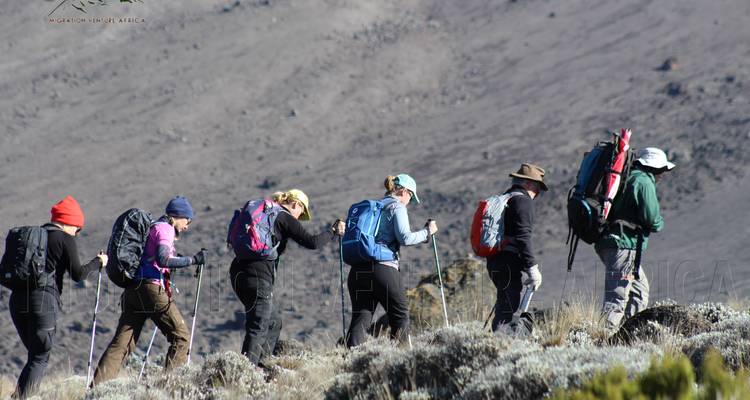
Experience an unforgettable Kilimanjaro Rongai Route 7 Days adventure, climbing Africa’s highest mountain via a scenic trail approaching from the northern side near the Kenyan border. Known for its quieter paths, beautiful wilderness, and relatively dry conditions, the Rongai Route offers a unique perspective of Mount Kilimanjaro and an incredible opportunity to reach Uhuru Peak at 5,895 metres above sea level.
During this seven-day trek, you will explore lush forests, open moorlands, dramatic alpine landscapes, and spectacular mountain scenery while gradually acclimatizing to the altitude. With experienced mountain guides and dedicated support staff, this journey combines adventure, natural beauty, and the rewarding challenge of summiting Kilimanjaro.
Because of its remote location, the route receives the least traffic of all the routes on Kilimanjaro and offers trekkers a relatively unspoiled wilderness experience where it is possible to see large wildlife like antelope, elephants, and buffalo.
The North-East side of the mountain gets significantly less moisture than the southern slopes which means that trekkers are less likely to encounter rain. Trekkers are also more likely to get clear, unclouded views of the mountain.
The Rongai Route is flatter than the other Kilimanjaro routes but because of its profile, it does not offer trekkers good options to climb high and sleep low.
It can be hiked on a six, seven, or even eight-day route. The seven or eight-day Rongai Routes are highly recommended as trekkers have extra days to acclimatize. Summit night from Kibo Hut is steep and follows the same path taken by Marangu trekkers which passes Gilman’s Point to Uhuru Peak. Then descends via the Marangu trail.

Highlights on Rongai Route 7:
- Departure and Return Place: Moshi Town to Lemosho Gate and then back to Kilimanjaro International Airport (Google Map)
- Departure Time: Please be ready by 8:15 AM for a prompt departure at 9:30 AM.
- Return Time: Approximately 10:30 AM on the last day.
- Dress Code: Casual. Comfortable athletic clothing, hiking shoes, hat, cold weather jacket, gloves, pants, and spare clothing.
- Accommodation: Two nights of accommodations based on Bed and Breakfast at 3 stars hotel (upgrades on request).
- Extensions: Trip Extensions are available on request
- Season: All year round
- Suitable for: Moderate fitness with previous trekking experience ideal
- Pros: It's less crowded, recommended during the rainy season, has an incredible view of the mountain throughout the hike by descending via Marangu for a diverse trek, high chances of spotting wildlife, and easy daily hikes.
- Cons: Not ideal for acclimatization, due to overnight camp placements, some find summiting through Kibo Hut camp harder than through Barafu
Departures everyday
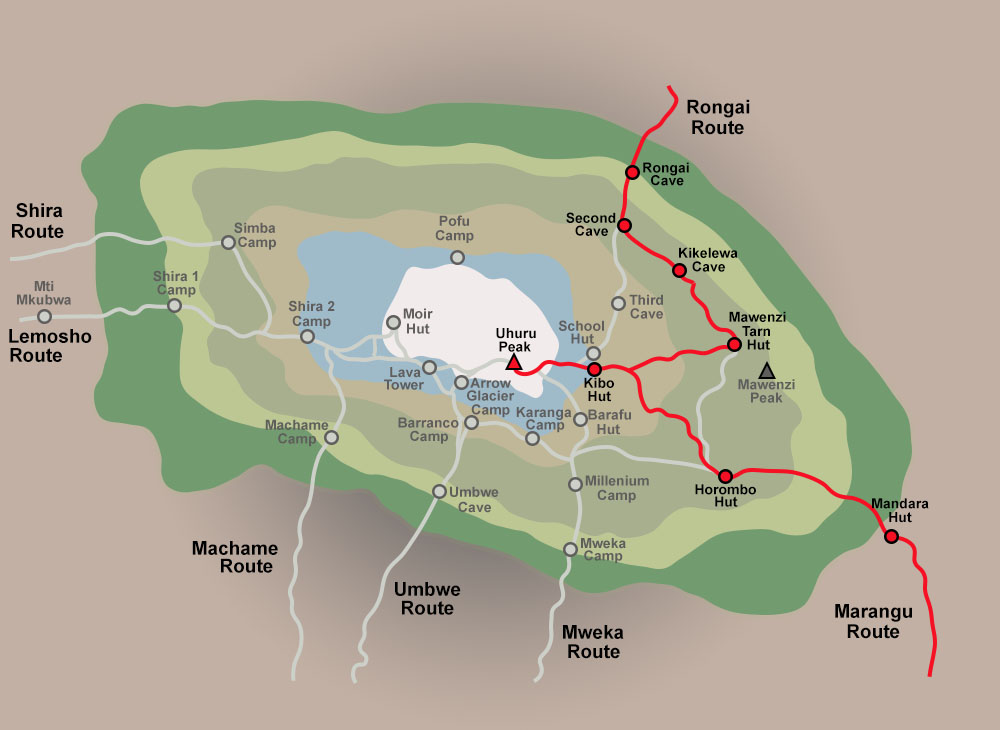
Itineraries
Day 1
Arrival
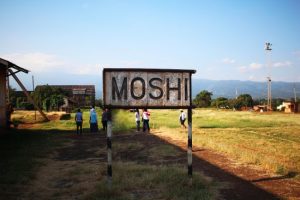
Arrival at Kilimanjaro international airport (JRO), where you will meet an Go Ahead Trip representative, and transfer to the hotel under the rate. The hotel will provide all the essential for a comfortable stay : cozy rooms , hot water , a swimming pool and internet access. In the evening there will be a briefing with our managers, who will also make sure you are ready to begin the climb.
Day 2
Rongai Gate – Rongai Caves Camp

We drive from Moshi to Marangu Gate for obtaining the permits required for the summit and then take a short road trip to the Rongai Gate trailhead. We’ll come across numerous corn and potato fields and climb gently through the forest areas which accommodate a variety of wildlife which also includes the black and white colobus monkeys.
Day 3
Second Caves Camp – Kikelewa Cave

The day will begin with a morning trek where we’ll steadily incline up to the Second Cave. Continuing on with the trek, we pass through the moorland toward the jagged peaks of Mawenzi leaving the main trail behind. Kikelewa Camp will be our destination for the day where we’ll be spending our night.
- Rongai Cave to Second Cave
- Elevation: 9,300 ft to 11,300 ft
- Distance: 6 km/4 miles
- Hiking Time: 3-4 hours
- Habitat: Heath
Second Cave to Kikelewa Cave
- Elevation: 11,300 ft to 11,811 ft
- Distance: 6 km/4 miles
- Hiking Time: 3-4 hours
- Habitat: Heath
Day 4
Kikelewa Cave – Mawenzi Tarn Camp
The hike today will be short and steep but along a grassy slope. It is surrounded by a vast wilderness area, and as we exit it, we enter the Alpine Desert zone and the landscape contrastingly alters. The campsites will be at the jagged areas of Mawenzi, Mawenzi Tarn to be precise. You’ll spend the rest of the day relaxing or exploring the surrounding area.
- Kikelewa Cave to Mawenzi Tarn
- Elevation: 11,811 ft to 14,160 ft
- Distance: 5 km/3 miles
- Hiking Time: 3-4 hours
- Habitat: Alpine Desert
Day 5
Mawenzi Tarn Camp – Mawenzi Ridge

You’ll be spending the entire day hiking at the Mawenzi Ridge which offer landscapes of Kibo and Mawenzi. This extra day is meant for acclimatization. After exploring the area to the fullest, we’ll then head back to Mawenzi Tarn to prepare our camp.
- Mawenzi Tarn to Mawenzi Ridge
- Elevation: 14,160 ft -14,400 ft
- Distance: 2 km/1 mile
- Hiking Time: 1-2 hours
- Habitat: Alpine Desert
Day 6
Mawenzi Tarn – Kibo Hut
Our camp, known as Kibo Hut, will be at the bottom of the Kibo Crater Wall. Once at the hut, we relax for the rest of the day and prepare for the upcoming summit day.
- Marwenzi Tarn to Kibo Hut
- Elevation: 14,160 ft to 15,430 ft
- Distance: 8 km/5 miles
- Hiking Time: 5-6 hours
- Habitat: Alpine Desert
Day 7
Kibo Hut – Uhuru Peak – Horombo Hut

Just past midnight, we’ll begin our summit to the top. This is considered the most challenging part of the journey when the wind and cold can be extreme at any period of the day. With short and frequent breaks, we ascend in the darkness. Once reaching at the Stella Point which is at an elevation of 18,900 ft, you’ll be rewarded with one of the stunning view of the sunrise coming over the Mawenzi Peak. Then we ascend all the way to the roof of Africa and highest point on Mount Kilimanjaro, the Uhuru Peak. After celebration of your accomplishment at the peak, we descend down to Horombo Hut. Later in the evening, we’ll be having our last dinner in the mountain and we’ll then go to sleep.
- Kibo Hut to Uhuru Peak
- Elevation: 15,430 ft to 19,341 ft
- Distance: 6 km/4 miles
- Hiking Time: 6-8 hours
- Habitat: Arctic
Uhuru Peak to Horombo Hut
- Elevation: 19,341 ft to 12,250 ft
- Distance: 16 km/10 miles
- Hiking Time: 4-5 hours
- Habitat: Heath
Day 8
Horombo Hut – Marangu Gate

On our last day, we have a long trek mostly downhill through the tropical rainforest. Once at the park headquarters at Marangu gate, we collect our summit certificates. Youth Adventures vehicle will meet us here and drive us back to the hotel in Moshi.
- Horombo Hut to Marangu Gate
- Elevation: 12,205 ft to 6,046 ft
- Distance: 20 km/12 miles
- Hiking Time: 5-7 hours
- Habitat: Rain Forest
Day 9
Departute
Rest in the hotel before the transfer to the airport for your flight home.
- Two way private airport transfers
- All park fees collected by the National Park
- Hotel ccommodations one night before and one night after the expedition
- Tented accommodation on Mount Kilimanjaro
- All meals on the hike
- All group equipment (dining tent, table, chairs, crockery and cutlery)
- Oxygen cylinders and oximeters
- Complete Expedition medical kits
- Professional guides licensed by Kilimanjaro National Park
- Dedicated support crew (assistant guides, camp master, porters, cooks, etc.)
- Government taxes
- Crew salaries
- Medical evacuations with AMREF Flying doctors
- Purified water while on the mountain
- Portable tented private flush toilet
- Personal Climbing gears
- Tanzania Visa on arrival
- Mountaineering Insurance
- Tips and Gratuities
- Personal Expenses (e.g. laundry, telephone, beverages, etc.)
The Rongai Route is the only established Kilimanjaro route that approaches the mountain from the north, near the Kenya–Tanzania border. It is known for being quieter, drier, and less crowded than the popular southern routes such as Machame and Lemosho
Most operators offer:
6-day Rongai Route
7-day Rongai Route (recommended)
Occasionally 8-day Rongai Route
The 7-day version includes an extra acclimatization day, improving comfort and summit success rates.
The extra day allows your body more time to adapt to altitude, reducing the risk of Acute Mountain Sickness (AMS) and increasing your chances of reaching Uhuru Peak. Many experienced climbers and guides recommend the 7-day itinerary over the 6-day option.
Success rates vary by operator and climber fitness, but typical estimates are:
Itinerary Success Rate
6 Days ~70–85%
7 Days ~85–95%
8 Days ~90–97%
Longer itineraries generally have higher success rates because of better acclimatization.
The Rongai Route is considered one of Kilimanjaro's easier routes because:
The ascent is gradual.
Trails are less steep than Machame or Umbwe.
There is less traffic on the route.
However, the summit night remains physically demanding due to altitude, cold temperatures, and the long climb to Uhuru Peak.
The 7-day Rongai Route is approximately:
73–79 km (45–49 miles) round trip
The exact distance varies slightly depending on the itinerary and acclimatization hikes.
Unlike the Marangu Route, the Rongai Route uses tents for most nights. Camps commonly include:
Simba Camp
Kikelewa Camp
Mawenzi Tarn Camp
Kibo Hut area (camping)
Horombo Hut area on descent
Most commercial operators provide tents, sleeping mats, and dining tents.
The best months are generally:
January–March
June–October
December
Because the northern side is drier, Rongai can also perform better than southern routes during shoulder rainy seasons.
You do not need technical climbing skills, but you should have:
Good cardiovascular fitness
Ability to hike 5–8 hours daily
Experience with multi-day trekking (helpful but not required)
Altitude adaptation is usually more important than athletic ability alone.
Yes. Anyone can develop altitude sickness regardless of age or fitness. To reduce risk:
Walk slowly ("pole pole")
Drink 3–4 liters of water daily
Eat well
Follow guide instructions
Choose the 7-day itinerary rather than the 6-day option
Related Trips

There are no reviews yet.