
- Overview
- Trip Outline
- Trip Includes
- Trip Excludes
- Reviews
- Booking
- FAQ
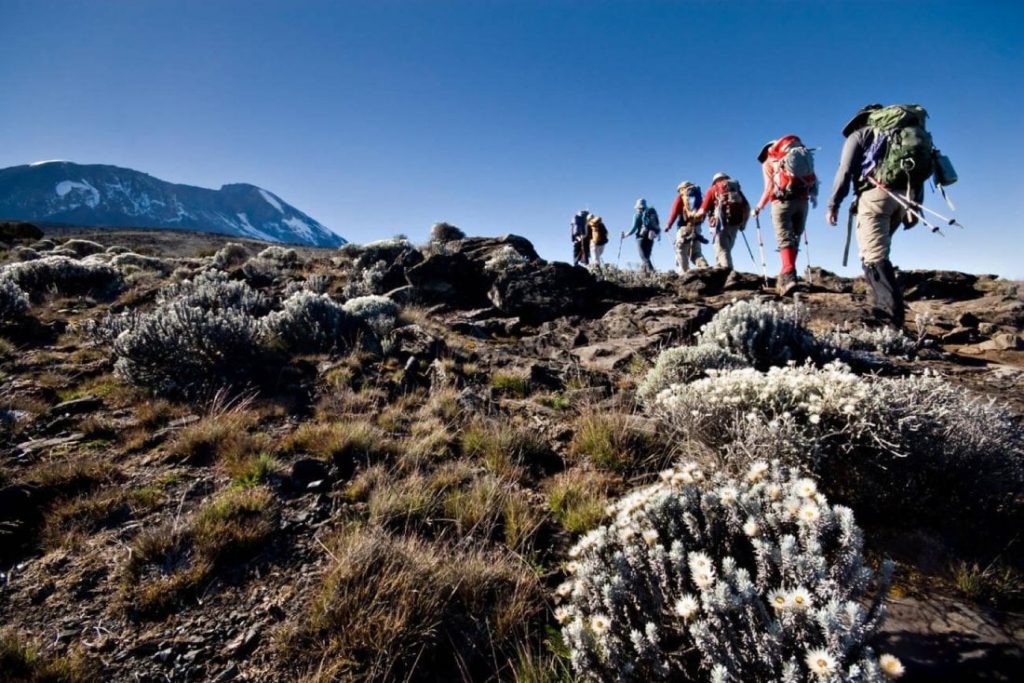
The Kilimanjaro Umbwe Route 6 Days adventure is one of the most challenging and scenic ways to climb Mount Kilimanjaro, offering steep trails, spectacular landscapes, and an unforgettable journey to Africa’s highest peak. Known for its direct ascent and demanding terrain, the Umbwe Route is best suited to experienced trekkers who are physically fit and prepared for a challenging mountain adventure.
During this six-day trek, you will pass through lush rainforests, dramatic ridges, alpine deserts, and breathtaking high-altitude landscapes before attempting to reach Uhuru Peak at 5,895 metres above sea level. With experienced mountain guides and dedicated support staff, this expedition offers an incredible opportunity to challenge yourself and experience the beauty of Kilimanjaro.
Spanning over 6 days on the mountain, this route provides breathtaking views and a sense of solitude, as it's less frequented compared to other paths.The journey begins in the lush montane forests, transitions through moorlands and alpine deserts, and culminates at the snow-capped summit of Uhuru Peak.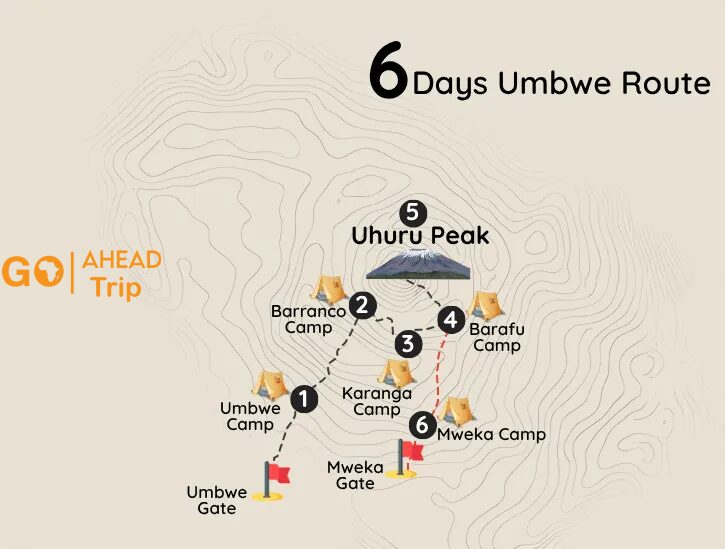
Tour Highlights Kilimanjaro Umbwe Route 6 Days
- Challenging Ascent: Tackle one of Kilimanjaro's most demanding routes, ideal for experienced hikers seeking a rigorous climb.
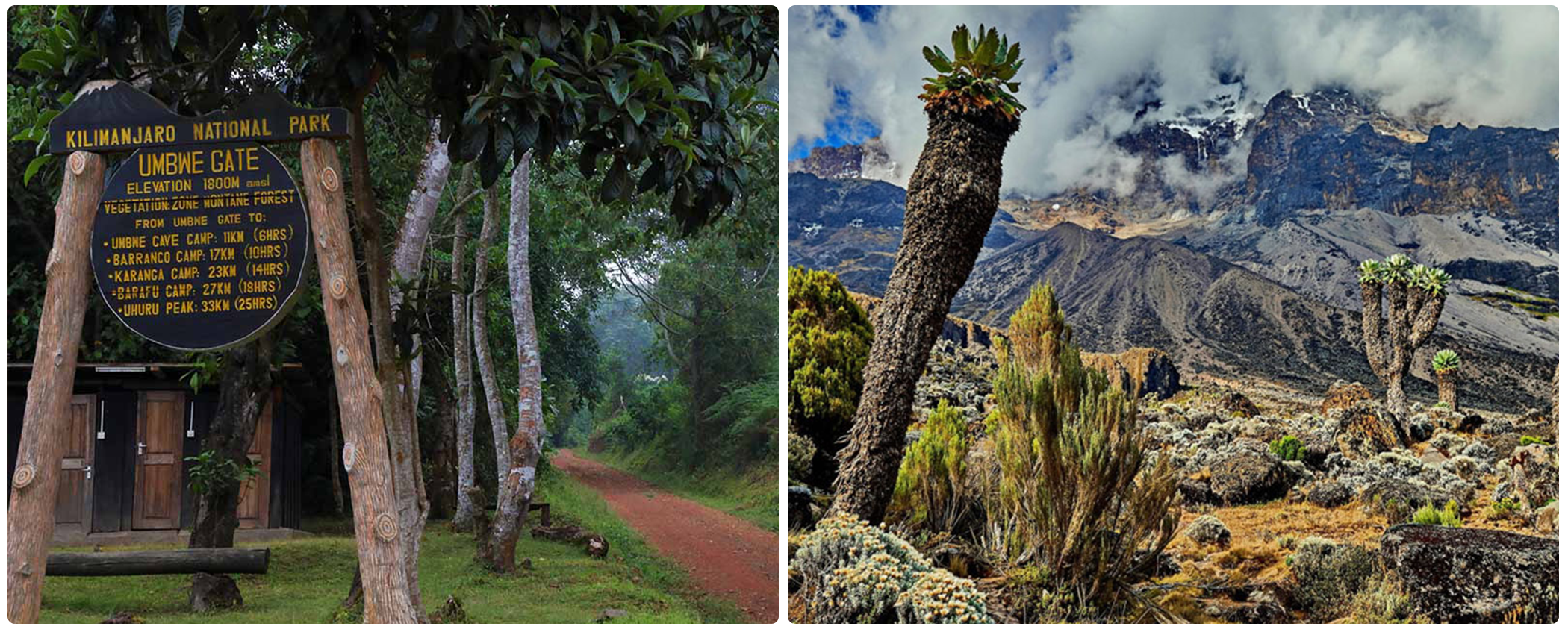
- Diverse Ecosystems: Traverse through varying landscapes, from dense rainforests to alpine deserts.
- Stunning Vistas: Enjoy panoramic views of the mountain's southern glaciers and the vast African plains.
- Less Crowded Path: Experience a more secluded trek, away from the busier routes.
- Summit Achievement: Reach Uhuru Peak, the highest point in Africa at 5,895 meters.
Contact us now to book your trip - Umbwe Route
Itineraries
Day 1
Arrival in Moshi
Upon your arrival at Kilimanjaro International Airport, you'll be warmly welcomed and transferred to your hotel in Moshi. This day is reserved for rest and preparation. In the evening, you'll meet your trekking guide for a detailed briefing about the upcoming adventure. They will also conduct an equipment check to ensure you're fully prepared for the climb. Missing gear can be rented at this time.
-
Accommodation: Hotel in Moshi (e.g., Panama Garden Resort)
- Meals: Dinner
- Elevation: Approximately 800 meters (2,625 feet)
Day 2
Umbwe Gate (1,600m) to Umbwe Cave Camp (2,900m)

After an early breakfast, you'll be driven to the Umbwe Gate, the starting point of your trek. The trail begins with a steep ascent through the lush montane rainforest. As you progress, the path narrows and becomes steeper, winding along a ridge between two rivers. The dense vegetation and towering trees provide a serene backdrop as you make your way to Umbwe Cave Camp.
- Accommodation: Camping at Umbwe Cave Camp
- Meals: Breakfast, Lunch, Dinner
- Elevation Gain: 1,300 meters (4,265 feet)
- Distance: 11 km (7 miles)
- Hiking Time: 5–7 hours
- Habitat: Montane Forest
Day 3
Umbwe Cave Camp (2,900m) to Barranco Camp (3,950m)

Leaving the rainforest behind, the trail ascends into the moorland zone. The vegetation becomes sparser, with moss-covered trees and rocky terrain. As you gain elevation, glimpses of Kilimanjaro's peak become visible. The path eventually flattens as you approach the Barranco Valley. Descending slightly, you'll arrive at Barranco Camp, situated beneath the impressive Barranco Wall.
- Accommodation: Camping at Barranco Camp
- Meals: Breakfast, Lunch, Dinner
- Elevation Gain: 1,050 meters (3,445 feet)
- Distance: 6 km (3.7 miles)
- Hiking Time: 4–5 hours
- Habitat: Moorland
Day 4
Barranco Camp (3,950m) to Karanga Camp (4,050m)

The day begins with a challenging climb up the Barranco Wall, a non-technical but steep ascent offering panoramic views of the surrounding landscape. Upon reaching the top, the trail undulates through a series of ridges and valleys before descending into the Karanga Valley. A final steep climb leads you to Karanga Camp. This shorter day aids in acclimatization.
- Accommodation: Camping at Karanga Camp
- Meals: Breakfast, Lunch, Dinner
- Elevation Gain: 100 meters (330 feet)
- Distance: 5 km (3.1 miles)
- Hiking Time: 4–5 hours
- Habitat: Alpine Desert
Day 5
Karanga Camp (4,050m) to Barafu Camp (4,640m)

Continuing from Karanga Camp, the trail intersects with the Mweka Trail before ascending towards Barafu Camp. The landscape is characterized by alpine desert, with sparse vegetation and expansive views. Upon arrival at Barafu Camp, you'll rest and prepare for the summit attempt, which begins around midnight.
- Accommodation: Camping at Barafu Camp
- Meals: Breakfast, Lunch, Dinner
- Elevation Gain: 590 meters (1,935 feet)
- Distance: 4 km (2.5 miles)
- Hiking Time: 3–4 hours
- Habitat: Alpine Desert
Day 6
Barafu Camp (4,640m) to Uhuru Peak (5,895m), then down to Mweka Camp (3,100m)

Around midnight, you'll commence the final ascent to Uhuru Peak, the highest point in Africa. The trail is steep and challenging, with cold temperatures and high altitude. Upon reaching the summit, you'll have time to take photos and savor your achievement. The descent follows the same path back to Barafu Camp for a short rest before continuing down to Mweka Camp.
- Accommodation: Camping at Mweka Camp
- Meals: Breakfast, Lunch, Dinner
- Elevation Gain: 1,255 meters (4,120 feet)
- Elevation Loss: 2,795 meters (9,170 feet)
- Distance: 5 km (3.1 miles) ascent, 12 km (7.5 miles) descent
- Hiking Time: 12–15 hours total
- Habitat: Arctic at the summit, descending through alpine desert and rainforest
Day 7
Mweka Camp (3,100m) to Mweka Gate (1,640m), then transfer to Moshi
After breakfast, you'll continue your descent through the lush rainforest to Mweka Gate. This final stretch is a gentle walk, allowing you to reflect on your journey. At the gate, you'll receive your summit certificate before being transferred back to your hotel in Moshi for a well-deserved rest.
- Accommodation: Hotel in Moshi
- Meals: Breakfast, Lunch
- Elevation Loss: 1,460 meters (4,790 feet)
- Distance: 10 km (6.2 miles)
- Hiking Time: 3–4 hours
- Habitat: Rainforest
Day 8
Departure

Depending on your flight schedule, you may have time to explore Moshi or relax at the hotel. When it's time, you'll be transferred to Kilimanjaro International Airport for your departure flight, marking the end of your unforgettable adventure.
-
Meals: Breakfast
- Two nights' accommodation in Moshi (before and after the trek)
- Private transport to and from Kilimanjaro International Airport
- All park fees, camping fees, and rescue fees
- Professional, experienced mountain guides and porters
- All meals on the mountain (breakfast, lunch, and dinner)
- Quality camping equipment (tents, sleeping bags, sleeping mats)
- Emergency oxygen and first aid kit
- Pulse oximeter for daily health monitoring
- Fair and ethical treatment of porters
- Filtered drinking water throughout the trek
- International flights to and from Tanzania
- Tanzania visa fees
- Travel and medical insurance
- Tips for guides, porters, and cook
- Personal trekking gear (available for rent)
- Optional activities and excursions
- Meals not specified in the itinerary
The Umbwe Route is widely regarded as the steepest and most challenging standard route on Mount Kilimanjaro. It approaches from the south side of the mountain and is known for rapid altitude gain, dramatic scenery, and low traffic.
The route is typically completed in 6 days, although some operators offer a 7-day version with an additional acclimatization day. The 7-day itinerary generally provides better summit success rates.
Several factors contribute to its difficulty:
Very steep ascent from the first day.
Rapid altitude gain with limited acclimatization time.
Physically demanding hiking days.
Challenging summit night due to accumulated fatigue and altitude.
Generally, no. Most guides recommend the Umbwe Route for experienced hikers, trekkers with previous altitude experience, or climbers seeking a more demanding challenge. First-time Kilimanjaro climbers are often advised to consider Machame, Lemosho, or Rongai instead.
The route is approximately 53 km (33 miles) round trip, making it one of the shortest routes on Kilimanjaro.
The Umbwe Route is a camping route. Climbers sleep in mountain tents at designated camps throughout the trek. Unlike the Marangu Route, there are no sleeping huts.
Very few climbers.
Direct and adventurous ascent.
Beautiful rainforest and ridge scenery.
Strong sense of wilderness.
Excellent option for experienced trekkers seeking a challenge.
The highest point is:
Uhuru Peak
Elevation: 5,895 m (19,341 ft) above sea level.
The most popular climbing seasons are:
January–March
June–October
December
These periods typically offer the most stable weather conditions on Kilimanjaro.
The 6-day Umbwe Route is best for:
Experienced hikers.
Climbers seeking a challenging ascent.
Trekkers who prefer fewer crowds.
Those with previous high-altitude experience.
Related Trips

Kilimanjaro Rongai Route 7 Days
Please login to add your wishlists.Conquer Africa’s highest peak on the 7-Day Kilimanjaro Rongai Route. Enjoy a quieter ascent, stunning mountain scenery, excellent acclimatization opportunities, and a rewarding summit experience to Uhuru Peak on Mount Kilimanjaro.


There are no reviews yet.