
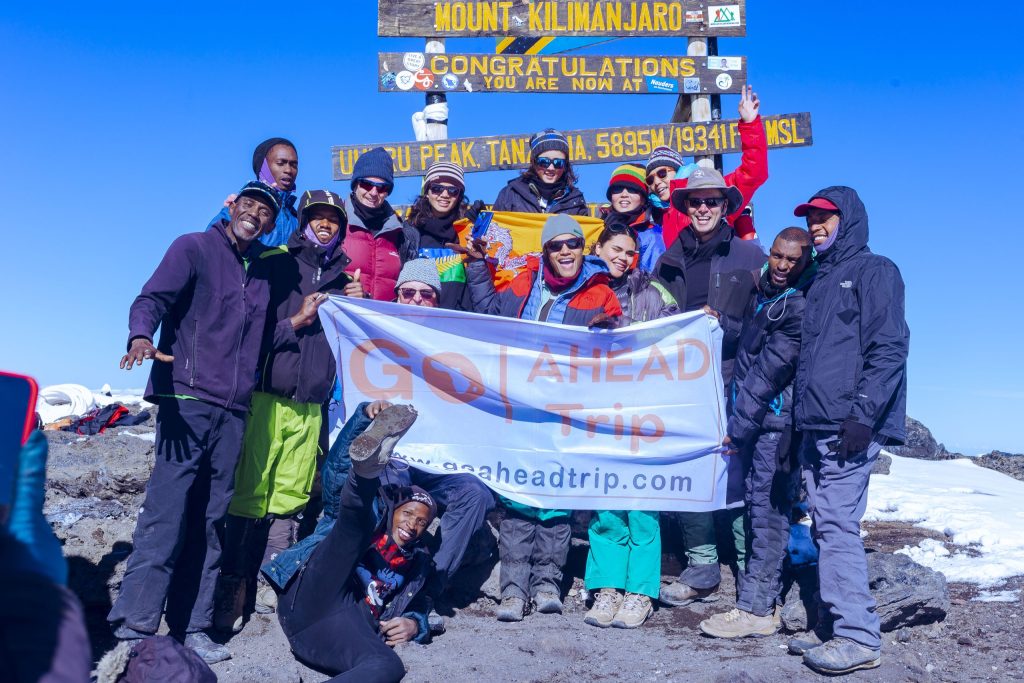
- Overview
- Trip Outline
- Trip Includes
- Trip Excludes
- Reviews
- Booking
- FAQ
Experience the Kilimanjaro Marangu Route 5 Days adventure with Go Ahead Trip and challenge yourself to reach the summit of Mount Kilimanjaro, Africa’s highest mountain. Known as the “Coca-Cola Route,” the Marangu Route features established trails, beautiful scenery, and comfortable mountain hut accommodation, making it a popular choice for climbers seeking a classic Kilimanjaro trekking experience.
During this five-day expedition, trek through lush rainforests, open moorlands, and breathtaking alpine landscapes before attempting to summit Uhuru Peak at 5,895 metres above sea level. Accompanied by experienced mountain guides and a dedicated support team, you will experience the beauty of Kilimanjaro while taking on an exciting and rewarding mountain adventure.
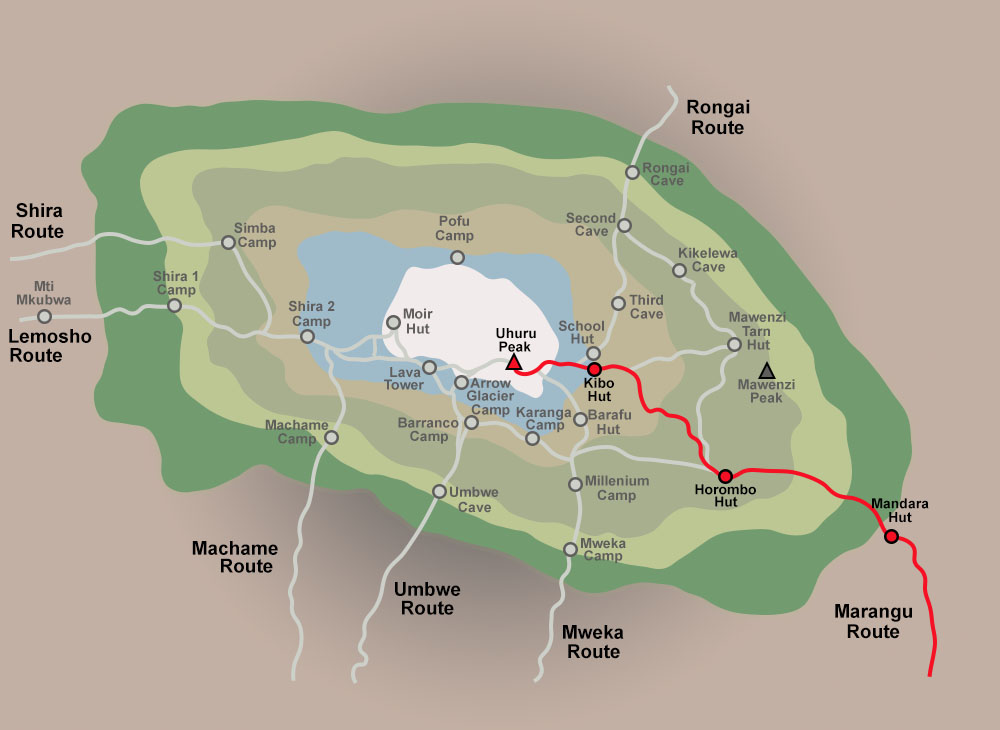 Marangu is the easiest of all the routes on Mount Kilimanjaro where the ascending is very much gradual and steady. This is much less painful and challenging as compared to the other routes. But as per the stats, only about 35% of the people reach the top, primarily because they are ill-prepared.
The trekking journey commences at the southeast area of the mountain near the Marangu Gate. It takes a minimum of five days to complete, however, six days is recommended and is deemed more practical. There are living structures all along the way with a dining hall and bunk beds all equipped with mattresses and pillows which are known as sleeping huts. Descend will be down the same path which sometimes makes the Marangu route seem overcrowded. It is cheaper to climb as well because of its small distance between the gate and Moshi, thus making it a shorter route to cover.
Highlights:
- Departure and Return Place: Moshi Town to Lemosho Gate and then back to Kilimanjaro International Airport (Google Map)
- Departure Time: Please be ready by 8:15 AM for a prompt departure at 9:30 AM.
- Return Time: Approximately 10:30 AM on the last day.
- Dress Code: Casual. Comfortable athletic clothing, hiking shoes, hat, cold weather jacket, gloves, pants, and spare clothing.
- Accommodation: Two nights of accommodations based on Bed and Breakfast at 3 stars hotel (upgrades on request).
- Customizations: Can be customized upon request, to meet traveler's needs
- Extensions: Trip Extensions are available on request
- Season: All year round
- Suitable for: Moderate fitness with previous trekking experience ideal
- Pros: One of the shorter routes, this may be an option for those on a tight time frame and/or budget. With accommodation in huts it can also be a good option during rainy season.
- Cons: Trek goes ascends and descends via the same path and approaches the summit from the steeper route via
Departures everyday
Itineraries
Day 1
Arrival
Arrival at Kilimanjaro international airport (JRO), where you will meet an Go Ahead Trip representative, and transfer to the hotel under the rate. The hotel will provide all the essential for a comfortable stay : cozy rooms , hot water , a swimming pool and internet access. In the evening there will be a briefing with our managers, who will also make sure you are ready to begin the climb.
Day 2
Marangu Gate (1860m) to Mandara Hut (2700m)
After breakfast and briefing, drive to the Kilimanjaro National Park Gate (about 1 hour), register, and commence the climb. Through the rainforest, you walk to the Mandara escarpment. If you want a better view of the surroundings including regions of Kenya and Tanzania, you should consider taking a side trip to Maundi Crater. In the rainforest, you can spot towering Eucalyptus trees, varied birdlife, and numerous Colobus monkeys.
- Distance covered: 8.3km / 5.2mi,
- Approx. time taken: 5 hours,
Day 3
Mandara Hut (2700m) to Horombo Hut (3700m)
You leave the glades of the rainforest and follow an ascending path on the open moorlands to the Horombo encampment. Views of Mawenzi and the summit of Kibo are amazing. Look for giant lobelias and grounsels. You may begin to feel the effects of the altitude.
- Elevation: 2700m/8875ft to 3700m/12,200ft
- Distance: 12km/7.5mi
- Hiking Time: 5-6 hours
- Habitat: Heathland
- Meals: BLD
Day 4
Horombo Hut (3700m) to Kibo Hut (4700m)
As we ascend further, we pass the last watering spot and walk into the saddle of Kilimanjaro which is in between the peaks of Kibo and Mawenzi. The rich vegetation starts once you advance into the upper heath land, but then gradually diminishes. Dinner will be arranged at the hut and you’ll relax and prepare for the next summit day.
- Elevation: 3700m/12,200ft to 4700m/15,500ft
- Distance: 9km/5.5mi
- Hiking Time: 5-6 hours
- Habitat: Alpine Desert
- Meals: BLD
Day 5
Kibo Hut (4700m) to UHURU PEAK (5895m) & down to Horombo Hut (3700m)
The trekking will resume between midnight to 2 am and we’ll head towards the summit to the Gilman’s Point which is at the crater rim through a route filled with heavy scree and snow. Following that, we’ll ascend to Uhuru Peak, the highest point in Africa. You’ll be gifted with unbelievable.Once at the summit, you can take pictures which you will act as souvenirs for your friends and family back home. After spending some time up there, you’ll be descending down to the Horombo escarpment. Lunch on route The climb will begin in way before sunrise in the darkness, thus you’ll be requiring headlamps and flashlights. Until you start descending, it’s going to be extremely cold and you’ll need warm layer of clothes. This will be by far the most demanding part of the trekking journey and a strong will power and an optimistic attitude is required to complete it!
- Elevation: 4700m/15,500ft to 5895m/19,340ft
- Down to 3700m/12,200ft
- Distance: 6km/4mi up / 15km/9mi down
- Hiking Time: 5-6 hours
- Habitat: Alpine Desert
- Meals: BLD
Day 6
Hike Horombo Hut (3700m) to Marangu Gate (1860m) And Drive to Moshi
Following breakfast, you’ll be descending down to the Mandara Hut through a moorland trail. Then through a lush forest path, you’ll be further descending to Marangu to the National Park gate. The lower elevations will most likely be muddy and wet where gaiters and trekking poles will come in handy. Shorts and t-shirts are more than enough to wear, however, do pack rain gear and warm clothes. Youth Adventures vehicle will be waiting for you at Marangu gate to drive you back to your hotel in Moshi (about 1 hour).
- Elevation: 3700m/12,200ft to 1700m/5500ft
- Distance: 20km/12.5mi
- Hiking Time: 4-5 hours
- Habitat: Forest
- Meals: B
Day 7
Departure
Rest in the hotel before the transfer to the airport for your flight home.
- Two way private airport transfers
- All park fees collected by the National Park
- Hotel ccommodations one night before and one night after the expedition
- Tented accommodation on Mount Kilimanjaro
- All meals on the hike
- All group equipment (dining tent, table, chairs, crockery and cutlery)
- Oxygen cylinders and oximeters
- Complete Expedition medical kits
- Professional guides licensed by Kilimanjaro National Park
- Dedicated support crew (assistant guides, camp master, porters, cooks, etc.)
- Government taxes
- Crew salaries
- Medical evacuations with AMREF Flying doctors
- Purified water while on the mountain
- Portable tented private flush toilet
- Personal Climbing gears
- Tanzania Visa on arrival
- Mountaineering Insurance
- Tips and Gratuities
- Personal Expenses (e.g. laundry, telephone, beverages, etc.)
We aim to keep the size of the public groups to a minimum, as we feel that a group that is much larger than ten trekkers is cumbersome and trekkers lose the sense that they are in a wilderness if there are too many people. That said, if you are a single, private group, then there is no problem accommodating you whatever the size of the group, as, of course, you will be aware before arriving in Tanzania of the number of people you will be trekking with.
The mountain is in Tanzania, East Africa, about 350km from the equator. The nearest towns are Moshi and Arusha.
Mount Kilimanjaro is the highest freestanding mountain in the world and the highest mountain in Africa. Its highest point is Uhuru Peak on the Kibo crater at 5895m above sea level.
None, but previous hiking or climbing experience will help. You need to be fit and healthy and have a good pair of worn-in hiking boots. The fitter you are the more you are likely to enjoy it.
There are at least six routes to the top, Uhuru peak. You will hike between 53 and 73km depending on which route you choose. The shortest and toughest is the 5-day Umbwe route. Allowing extra days will help you to acclimatize better and improve your chances of reaching the summit. The easiest and most popular route is Marangu (which can be done in five), but we use six days for this route.
You will eat normal food: potatoes, rice, pasta, vegetables, eggs, sandwiches, cheese, and fruit. When you book a trek, let your tour operator know about food allergies or medical conditions that require special diets. Non-vegetarians will be served sausages, chicken, and meat. Tea, coffee, and hot chocolate will be available as well.
Yes, it is expected and much appreciated. The amount depends on the number of days, but can range from $150 and $300 per hiker. Tips are pooled and shared amongst the crew. Bring US dollar bills.
There are no charging stations on Mount Kilimanjaro. We recommend bringing Power Banks and spare batteries. There are charging ports in our safari vehicles.
Your mountain camps are set up and broken down each day by expert camp porters. You’ll stay in double occupancy all-weather tents with full-ground pads to keep you and your gear dry. Private toilet tents, solar-lit dining tents with tables and chairs, and basins of hot water for washing are provided in every camp. Grand Traverse treks include upgraded solar-lit walk-in-height sleeping tents with mountaineering beds and mattresses for additional comfort.
Yes, we do arrange this. Please send your request to Safari.
Mount Kilimanjaro can be climbed anytime throughout the year. Most travelers prefer climbing during the dry seasons: December to March, June to October. Many consider the best months to climb Kilimanjaro to be January, February, and September.
Related Trips

Kilimanjaro Rongai Route 7 Days
Please login to add your wishlists.Conquer Africa’s highest peak on the 7-Day Kilimanjaro Rongai Route. Enjoy a quieter ascent, stunning mountain scenery, excellent acclimatization opportunities, and a rewarding summit experience to Uhuru Peak on Mount Kilimanjaro.


There are no reviews yet.